
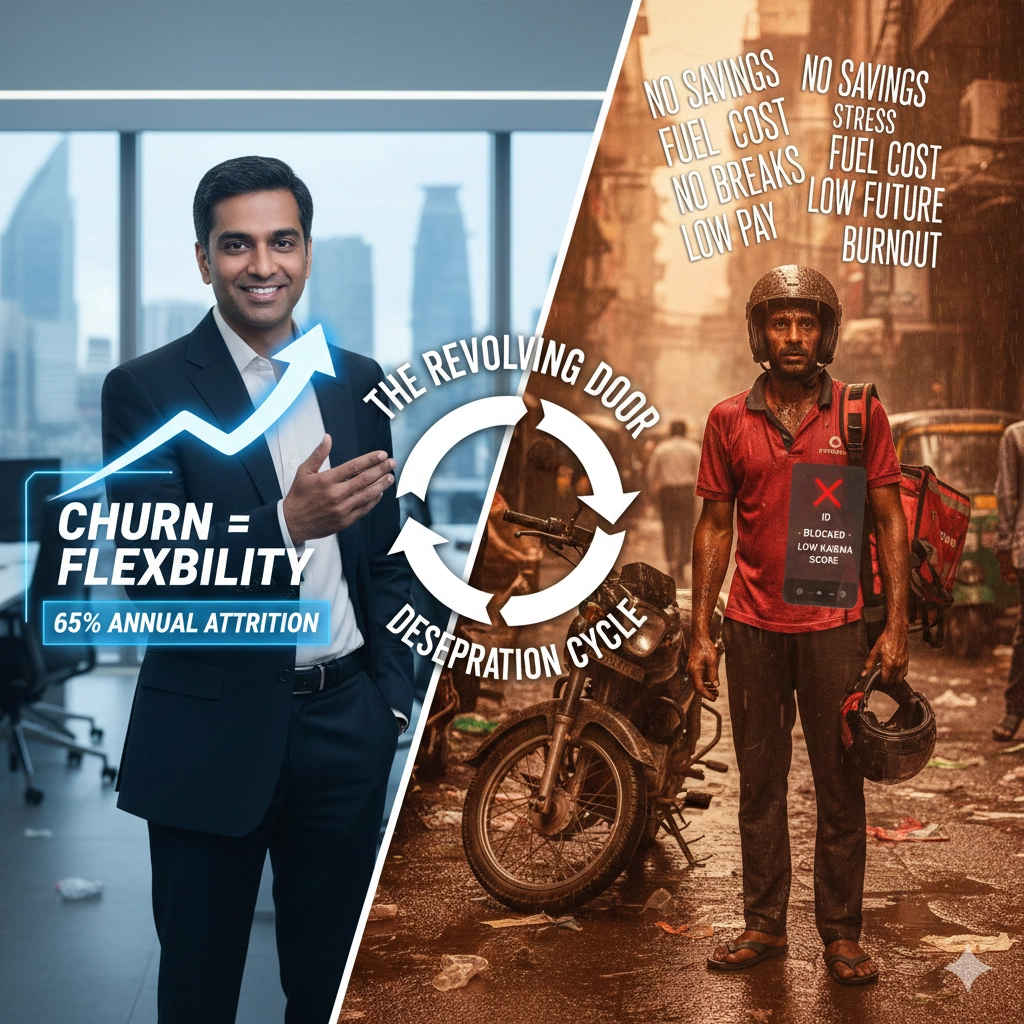
The Revolving Door: Why Deepinder Goyal’s "Churn" Narrative Ignores the Worker’s Reality
In a recent series of public statements and data disclosures, Zomato CEO Deepinder Goyal framed the sector's staggering 65% annual attrition rate as a badge of honor. To Goyal, "churn" is proof that the gig model is working: a frictionless, flexible "stop-gap" for people to earn quick cash before moving on to bigger things.
However, for the lakhs of riders navigating India’s heat, rain, and traffic, this high turnover isn't a sign of success. It is a symptom of a system designed to burn through human labor until there is nothing left. Here is why the "flexibility" narrative fails to capture the true cost of the churn.
1. Desperation is Not a "Choice"
Goyal argues that workers join for a few months and leave voluntarily. But workers and unions, such as the Telangana Gig and Platform Workers Association (TGPWA), argue that people leave because they cannot afford to stay. * The "Net" Reality: While Goyal cites average earnings of ₹102 per hour, the math changes on the road. After deducting fuel, EMI for the bike, smartphone data, and maintenance, a rider’s net take-home pay often drops to ₹75–₹81 per hour.
Zero Career Path: In a traditional job, seniority brings raises and security. In the gig economy, a rider on day 1,000 earns the same (or sometimes less due to incentive changes) as a rider on day 1. Churn happens because the job is a dead-end, not a stepping stone.
2. The "Shadow Timer" and Algorithmic Pressure
Goyal maintains that there is no "timer" forcing riders to speed, attributing 10-minute deliveries to store density. Yet, workers describe a "shadow timer" created by the platform's incentive structures.
To make a living wage, riders must hit "milestone" targets.
Missing a single delivery by a few minutes can cascade into missing a daily bonus, effectively shaving 20-30% off their daily income. The high churn rate is often just the sound of exhausted workers finally collapsing under the weight of these invisible countdowns.
3. The Myth of the "Small Number of Miscreants"
Following the New Year's Eve strikes, Goyal dismissed protestors as "miscreants" or politically motivated agents. This ignores the systemic issues that led to the strike:
Arbitrary Terminations: Zomato terminates roughly 5,000 workers every month for "fraud." Many workers report being blocked by automated systems with no human recourse, often for issues like app glitches or customer disputes.
The "Karma" Score: The platform uses a "Karma Score" to judge reliability. For a worker, a low score isn't just a metric; it's the threat of instant homelessness.
4. Visibility vs. Responsibility
In a controversial move, Goyal suggested that public outrage is actually "rich guilt"—that we are only uncomfortable because the gig economy has made the poor visible at our doorsteps.
"The doorbell is not the problem," Goyal wrote.
But workers argue that the "visibility" Goyal speaks of is being used as a shield. By reframing the debate as a "moral reckoning" for the consumer, the platform avoids the structural reckoning it owes its workers: fair wages, social security, and the right to a grievance mechanism.
The Bottom Line
High churn isn't a sign that the "gig style" is thriving; it is an indicator of instability. When 65% of your workforce leaves every year, you aren't running a "job creation engine"—you are running a revolving door fueled by India's unemployment crisis. People aren't "graduating" from Zomato they are being ground down by it.